
How do you want to shop?
What Are Cannabis Topicals? A Simple Guide for Beginners

by Puff Cannabis | September 17, 2026
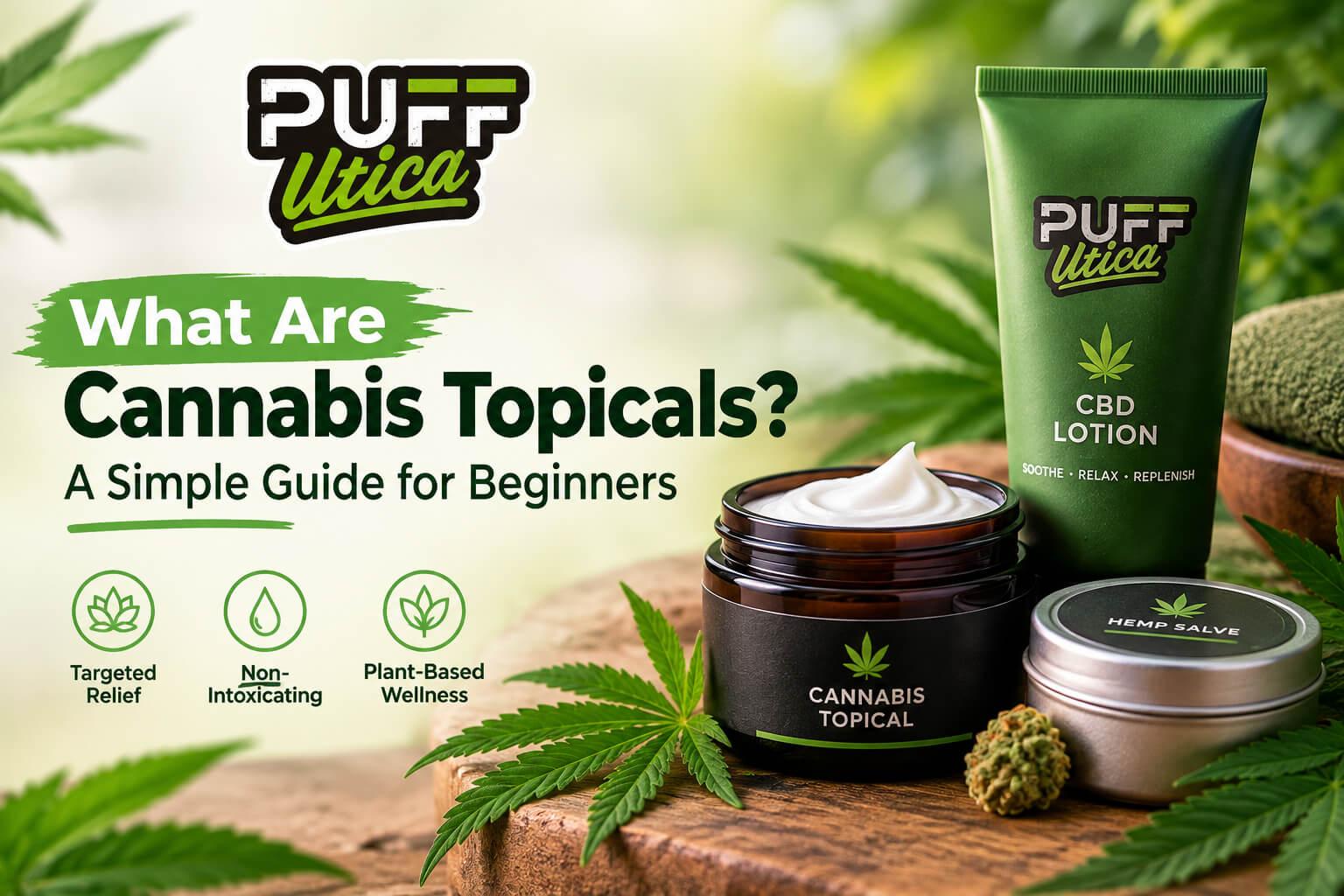
Cannabis comes in many forms, but not every product is meant to be inhaled or eaten. Cannabis topicals offer another option by applying cannabinoids directly to the skin. They come in creams, lotions, balms, gels, oils, and other formats. However, each product can work differently depending on its formula.
So, what are cannabis topicals, and how should beginners use them? This guide explains how they work, common types, THC and CBD differences, safety, labels, and more.
A Different Way to Experience Cannabis
Cannabis topicals are designed for use on the skin rather than through smoking, vaping, or eating. That difference makes them interesting for people who prefer a targeted application.
Unlike inhaled cannabis, topicals do not involve the lungs. They also differ from edibles because they are not designed to travel through the digestive system.
For beginners, this can make topicals feel like a completely different category of cannabis product. Still, understanding the label and ingredients remains important before trying one.
What Makes a Cannabis Topical Different?
A cannabis topical is a product that contains cannabinoids and is intended for application to the skin. Common cannabinoids include THC and CBD.
The base may include ingredients such as oils, waxes, botanical extracts, or moisturizing agents. Therefore, two products with similar cannabinoid amounts can still feel very different on the skin.
Topicals also focus on specific application areas. For example, someone may apply a cream to their hands, shoulders, legs, or another area listed on the product label.
How Topicals Differ from Cannabis You Inhale or Eat:
Smoking and vaping send cannabinoids into the lungs. From there, cannabinoids enter the bloodstream and can produce whole-body effects.
Edibles take a different route. The digestive system processes the cannabinoids before they enter circulation.
Traditional cannabis topicals are mainly designed for local skin application. However, transdermal products are different because they are specifically designed to move cannabinoids through the skin.
What Are Cannabis Topicals?
If you are wondering what is a cannabis topical the answer is fairly simple. It is a cannabis or cannabinoid-infused product made for application to the skin.
Common examples include creams, lotions, balms, salves, ointments, gels, and oils. Some products may contain THC, CBD, or a combination of cannabinoids.
The exact experience depends on the product's formulation. Therefore, beginners should focus on the complete product label instead of looking only at the THC or CBD number.
What Is a Cannabis Topical Made Of?
Cannabis topicals usually contain two main parts. First, there is a cannabinoid component. Second, there is a base that helps spread the product across the skin.
The base can vary widely between products. For example, one cream may feel light and absorb quickly, while a balm may feel thicker and stay on the skin longer.
Common supporting ingredients can include:
1. Coconut oil
2. Shea butter
3. Beeswax
4. Aloe vera
5. Botanical extracts
6. Carrier oils
7. Moisturizing ingredients
8. Cooling ingredients
9. Fragrance or essential oils
Because formulas vary, always read the complete ingredient list before applying for a new product.
THC, CBD, and Other Cannabinoids in Topicals:
THC and CBD are two of the most familiar cannabinoids found in cannabis products. However, they are not the same.
THC is the cannabinoid associated with the intoxicating effects of cannabis. CBD does not produce the typical cannabis high.
Other cannabinoids may also appear in some products. These can include CBG and CBN, depending on the formulation.
So, what is the difference between THC and CBD topicals? The main difference starts with the cannabinoid profile. However, the product's base, concentration, and other ingredients also matter.
Quick Comparison: THC vs. CBD Topicals:
Feature | THC Topical | CBD Topical |
Main cannabinoid | THC | CBD |
Intoxicating effect | Traditional topical usually not designed to cause a high | CBD is not intoxicating |
Common formats | Creams, balms, lotions, gels | Creams, lotions, balms, oils, gels |
What to check | THC amount and full label | CBD amount and full label |
Best approach for beginners | Follow product directions carefully | Follow product directions carefully |
Important difference | Some transdermal THC products can produce systemic exposure | Transdermal CBD products can also be designed for skin-to-bloodstream delivery |
The exact effects depend on the product formulation and delivery method. Therefore, do not judge a product only by whether it contains THC or CBD.
How Cannabis Topicals Work on the Skin
Many beginners ask, how do cannabis topicals work? The answer involves both the product formula and the biology of the skin.
Research shows that the skin contains an endocannabinoid system. This system includes cannabinoid-related receptors and signaling pathways. However, researchers are still studying exactly how different cannabinoids interact with the skin.
Therefore, it is better to avoid simple claims that every topical works the same way. Product formulation can strongly affect how cannabinoids interact with the skin.
The Role of Cannabinoids and the Skin:
The skin acts as a protective barrier. It controls how substances move into and through different skin layers.
When you apply a topical, its ingredients interact with the outer skin surface. Some cannabinoids may remain mainly near the application area.
However, absorption depends on several factors. These include the formulation, cannabinoid concentration, skin condition, and other ingredients.
Research on topical cannabinoids remains developing. Current reviews also note challenges involving skin penetration and inconsistent bioavailability.
Topical vs. Transdermal Cannabis Products:
Understanding this difference is especially important for beginners.
A topical is generally designed to work at or near the skin where it is applied. A transdermal product is specifically designed to move ingredients through the skin and potentially into the bloodstream.
Some specially designed transdermal cannabinoid systems can produce systemic exposure. However, this does not mean ordinary cannabis creams work the same way.
Topical vs. Transdermal: Simple Comparison:
Feature | Traditional Topical | Transdermal Product |
Main purpose | Local skin application | Delivery through the skin |
Intended location | Skin and nearby area | Across the skin barrier |
Systemic exposure | Usually not the primary goal | May be the intended goal |
Common formats | Creams, lotions, balms, gels | Patches and specially formulated systems |
Intoxicating potential | Generally, not designed for a high | Depends on cannabinoid and formulation |
Beginner tip | Follow the label | Read the delivery information carefully |
Always check the product description before assuming how a cannabis product will affect you.
Common Types of Cannabis Topicals
Beginners may find many different product types when browsing a cannabis menu. Fortunately, the main differences are usually easy to understand.
The most common formats include creams, lotions, balms, salves, ointments, gels, and oils.
Each format can have a different texture and application style. Therefore, choosing the right format often comes down to personal preference and intended use.
Creams and Lotions:
Creams and lotions are popular choices because they are easy to spread across the skin.
Lotions often have a lighter texture. Creams may feel thicker and more moisturized.
When learning how to apply cannabis cream, start with a small amount. Apply it to clean, intact skin unless the product label says otherwise.
Then, follow the manufacturer's directions. Avoid applying more simply because you do not notice an immediate sensation.
Balms, Salves, and Ointments:
Balms and salves usually have thicker textures than lotions or creams. They may contain waxes and oils that create a heavier layer on the skin.
This texture can make them useful for targeted applications. However, they may feel different from lightweight cream.
Always consider the ingredients if you have sensitive skin. A botanical or scented ingredient can cause irritation in some people.
Gels, Oils, and Other Topical Formats:
Gels can have a lighter feel and may spread easily. Oils can also work well for targeted applications or massages.
Some products use additional ingredients to create cooling or warming sensations. These sensations do not necessarily mean the cannabinoids themselves are producing the effect.
Because formulations vary so much, read the label before using any product. The product instructions should guide the amount, frequency, and application method.
Common Cannabis Topical Formats:
Product Type | Typical Texture | Beginner Consideration |
Cream | Medium and smooth | Easy to spread |
Lotion | Light and fluid | Useful for larger areas |
Balm | Thick and oily | Good for targeted application |
Salve | Thick and waxy | May stay on the skin longer |
Ointment | Very thick | Check ingredients carefully |
Gel | Light and smooth | Often easy to spread |
Oil | Liquid and slippery | Can work well for massage |
The best format depends on your personal preference, skin needs, and the manufacturer's directions.
What Are Cannabis Topicals Used For?
So, what are cannabis topicals used for?People commonly choose them for localized skin and body-care routines.
Some consumers use cannabinoid topicals as part of a personal wellness routine. Others prefer them because they can apply the product to a specific area instead of using an inhaled product.
However, research does not support treating every topical as a proven medical treatment. Evidence varies by cannabinoid, product, condition, and formulation.
Current research continues to explore topical cannabinoids. However, researchers also emphasize that more high-quality human studies are needed before broad medical conclusions can be made.
Localized Skin and Body Care:
Cannabis topicals are commonly used as part of localized body-care routines.
For example, someone may choose a cream for a particular area after exercising or during a personal skincare routine.
Some products also contain moisturizing or botanical ingredients. Therefore, the overall formula matters just as much as the cannabinoid content.
Still, avoid if a cannabis topical will produce the same results for everyone.
Why People Choose Topicals Instead of Other Cannabis Products:
There are several reasons someone may prefer a topical.
For example:
1. It does not require smoking or vaping.
2. It can be applied to a specific area.
3. It fits easily into some skincare routines.
4. It comes in several textures.
5. It allows consumers to avoid edible digestion.
6. It may be easier to use discreetly.
However, personal preferences differ. Therefore, the best format depends on what feels comfortable and practical for you.
Will Cannabis Topicals Make You Feel High?
One of the biggest beginner questions is do cannabis topicals get you high?
Traditional topical products are generally intended for local application and are not designed to create the same intoxicating effect as inhaled or edible cannabis.
However, beginners should not assume every skin-applied cannabis product is non-intoxicating. Transdermal products are specifically designed to deliver cannabinoids through the skin.
So, do THC topicals make you high? A conventional THC topical is generally not expected to create the typical high. However, a transdermal THC product can be different.
Likewise, do CBD topicals make you high? CBD itself does not produce the typical intoxicating cannabis high.
Why Traditional Topicals Usually Have Local Effects:
Traditional topicals are designed primarily for application to the skin.
Their formulation can limit how much cannabinoid reaches systemic circulation. However, absorption can vary between products.
Research has found that topical cannabinoid formulations can differ in how they interact with and pass-through skin. This is another reason product formulation matters.
Therefore, it is safer to rely on the product label than make assumptions based only on the word "topical."
Why Transdermal Products Are Different:
Transdermal products are specifically formulated to move substances through the skin.
Some systems can therefore deliver cannabinoids into the bloodstream. Human research has demonstrated systemic cannabinoid exposure from specially designed transdermal systems.
That does not mean every transdermal product cause intoxication. The effects depend on the formulation and cannabinoid dose.
For beginners, the easiest rule is simple: check whether the product is topical or transdermal before using it.
Understanding Cannabis Topical Potency and Labels
A product label can tell you much more than the product name.
Understanding the label helps beginners make more informed choices. It also reduces the chance of using more products than intended.
Remember that a larger cannabinoid number does not automatically make a product better. Instead, consider the complete formulation and how you plan to use it.
What Does THC or CBD Milligram Content Mean?
Milligrams tell you how much of a cannabinoid the product contains.
However, the number can represent the entire container rather than one application. Therefore, always read the label carefully.
For example, a jar may contain a stated total amount of THC or CBD. That does not mean the entire amount should be used at one time.
Follow the manufacturer's directions for application amount and frequency.
Why Higher Potency Does Not Always Mean Better:
More THC or CBD is not automatically better.
A stronger product may not match your preferences or experience level. Additionally, a higher cannabinoid concentration does not tell you everything about the formula.
Beginners may prefer starting with a product that has clear instructions and a straightforward ingredient list.
The goal is to choose a product you understand, not simply the strongest product available.
Why the Full Product Label Matters:
The label provides important information about the product.
Look for:
1. THC and CBD content
2. Other cannabinoids
3. Ingredient list
4. Suggested application
5. Manufacturer information
6. Product warnings
7. Storage instructions
8. Batch or testing information, when provided
Because cannabis topical formulations can vary widely, the complete label is more useful than a single potency number.
Are Cannabis Topicals Safe for Beginners?
Many people ask, are cannabis topicals safe for first-time users?
The answer depends on the individual and the specific product. Skin reactions can happen with many types of skincare products, including cannabinoid products.
Research on topical cannabinoids is still developing. Reviews have noted that scientific evidence has not yet caught up with the growing number of topical products available to consumers.
Therefore, beginners should take a careful and simple approach.
Possible Skin Reactions and Sensitivities:
Some people may experience irritation from ingredients in a topical.
Potential reactions can include redness, itching, dryness, burning, or discomfort. These reactions may come from the cannabinoid itself or another ingredient.
Fragrances and botanical extracts can also bother sensitive skin.
If you have sensitive skin, consider choosing a simple formula. A small patch test may also help you identify potential irritation before wider use.
Why You Should Check the Full Ingredient List:
The cannabinoid is only one part of a topical product.
The formula may contain fragrances, essential oils, cooling ingredients, carrier oils, or botanical extracts. Any of these ingredients may matter if your skin reacts easily.
Therefore, read the full ingredient list before applying for a new product.
Also, follow the label's instructions about where the product should and should not be applied.
When to Stop Using a Topical and Seek Professional Advice:
Stop using a topic if you develop a significant or worsening skin reaction.
For example, severe swelling, intense irritation, breathing problems, or other serious symptoms require prompt medical attention.
If a reaction continues after stopping the product, speak with a healthcare professional.
Also, discuss cannabis products with a qualified healthcare professional if you take medications or have concerns about interactions.
Cannabis Topicals vs. Other Cannabis Products
Different cannabis products offer different delivery methods.
The best choice depends on your preferences, experience, and the type of experience you want.
Topicals vs. Flower and Pre-Rolls:
Flower and pre-rolls are inhaled. Topicals are applied to the skin.
Inhaled cannabis can produce whole-body effects quickly. Traditional topicals are instead designed for application to a specific area.
Therefore, these products serve very different purposes.
Topicals vs. Edibles:
Edibles are eaten and processed through the digestive system.
They can take longer to produce noticeable effects. Their effects can also last much longer than inhaled cannabis.
Topicals avoid the digestive route. However, ordinary topicals are not designed to create the same whole-body experience as edibles.
Topicals vs. Vapes:
Vapes deliver cannabinoids through inhalation.
Topicals, on the other hand, are applied directly to the skin.
This makes them two very different product categories. Beginners should choose based on their preferred delivery method rather than simply comparing THC or CBD numbers.
Frequently Asked Questions About Cannabis Topicals
What Are Cannabis Topicals Used For?
Cannabis topicals are commonly used for localized skin and body-care routines. They may contain THC, CBD, or other cannabinoids.
Research into their potential uses continues to develop. Therefore, consumers should avoid treating general product claims as guaranteed medical results.
Do Cannabis Topicals Get You High?
Traditional cannabis topicals generally are not designed to produce the typical cannabis high.
However, transdermal products are different. They can deliver cannabinoids through the skin and may create systemic exposure.
Always check the product description and label before use.
How Long Do Cannabis Topicals Take to Work?
There is no single answer for every product.
The timing can depend on the formulation, ingredients, application area, and individual factors. Some users may notice a sensation relatively soon, while others may notice less.
Therefore, follow the product's instructions and avoid repeatedly applying more because you do not immediately notice an effect.
How Long Do Cannabis Topicals Last?
The duration can vary between products and individuals.
Formula, cannabinoid concentration, application area, and personal factors can all affect the experience.
Because there is no universal timing for every topical, the manufacturer's directions are the best starting point.
Are THC Topicals Different from CBD Topicals?
Yes.
THC and CBD are different cannabinoids. THC is associated with cannabis intoxication, while CBD does not produce the typical high.
However, the overall product experience also depends on the formulation and other ingredients.
Can Beginners Use Cannabis Topicals?
Yes, beginners can explore cannabis topicals when they understand how the product works.
Start by reading the label and checking the ingredients. Then, follow the recommended application directions.
A simple product with clear labeling may be easier for a first-time consumer to understand.
Final Thoughts: Finding a Cannabis Topical That Fits Your Routine
Understanding what cannabis topicals are does not have to be complicated. They are cannabis or cannabinoid-infused products designed for application to the skin.
Creams, lotions, balms, salves, gels, and oils are among the common formats. However, each product can have a different formulation and intended use.
Most importantly, beginners should understand the difference between traditional topicals and transdermal products. They should also check THC and CBD content, ingredients, directions, and warnings before using them.
Research into cannabis topicals continues to grow. Current evidence suggests that formulation matters greatly, while more high-quality human research is still needed.
If you are comparing cannabis topicals in Utica, focus on choosing a product that matches your preferences and experience. A clear label and thoughtful product selection can make your first experience easier to understand.
Ultimately, the right topical is not necessarily the strongest one. Instead, it is the product you understand, can use as directed, and feel comfortable adding to your routine.